I cleared The Adventures of Elliot and the Millennium Tale, which was released on 6/18, so I want to share my impressions while keeping spoilers to a minimum.
The first thing I’ll say is that the full game had the same things I expected from the demo, so I had a great time with it.
The “RPG” in Action RPG Is JRPG
First, I want to write about this game’s genre. Officially, the game is labeled an “Action RPG.” But the meaning of this RPG is not the general one of a WRPG, where you level up, allocate stats, and build a character; it is more natural to think of it as a JRPG that emphasizes characters and story.
There are equipment systems such as weapons and accessories, and weapons can be fitted with magic stones that grant special abilities, so there is a certain RPG-like feel in the equipment system. But for the protagonist Elliot, there is only a health upgrade and nothing beyond that, so you cannot really play in a way that involves deeply building your own character. In addition, the protagonist’s character and personality are firmly established, and there is no change to them based on the player’s choices. That is why I see it this way.
So the rest of this review will be written from the perspectives of action and JRPG.
Action: Satisfying Combat (Normal Difficulty)
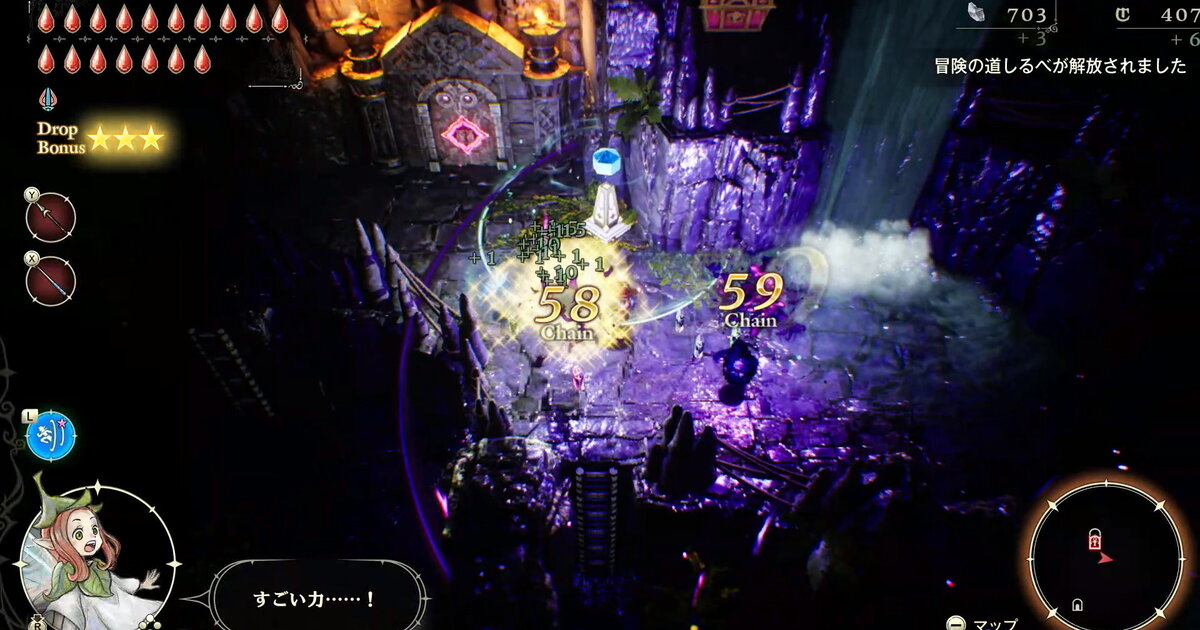
The combat was simply satisfying.
First, the sound design is excellent. The crackling sound when hits land, the light popping sound when enemies are defeated, the jingling sound when picking up the gems enemies drop (rupees, in Zelda terms) — everything is fun to listen to.
The difficulty is also just right. On Normal, regular enemies in the field go down in one or two regular attacks, and even somewhat tougher enemies fall to one or two special attacks or charged attacks. That lets you keep chaining together consecutive kills, while taking damage from a hit or mistake can break the chain, so the game still demands careful positioning and movement. I liked how it keeps each individual fight simple while giving the whole sequence of battles tension through the chain system.
Above all, the just-guard/parry window is easy to hit, and the reward for landing it is huge, which makes it feel great. I suspect the parry window is pretty long by default, and enemies flash red right before attacks that can be parried, which makes it easy to react and parry on sight. And when you do parry, the reward is absurdly strong: close-range attacks stun the enemy, while ranged attacks are reflected. Easy to use, powerful, and satisfying to hear — it got so addictive that I ended up parrying enemy attacks constantly.
JRPG: A Story of Hope
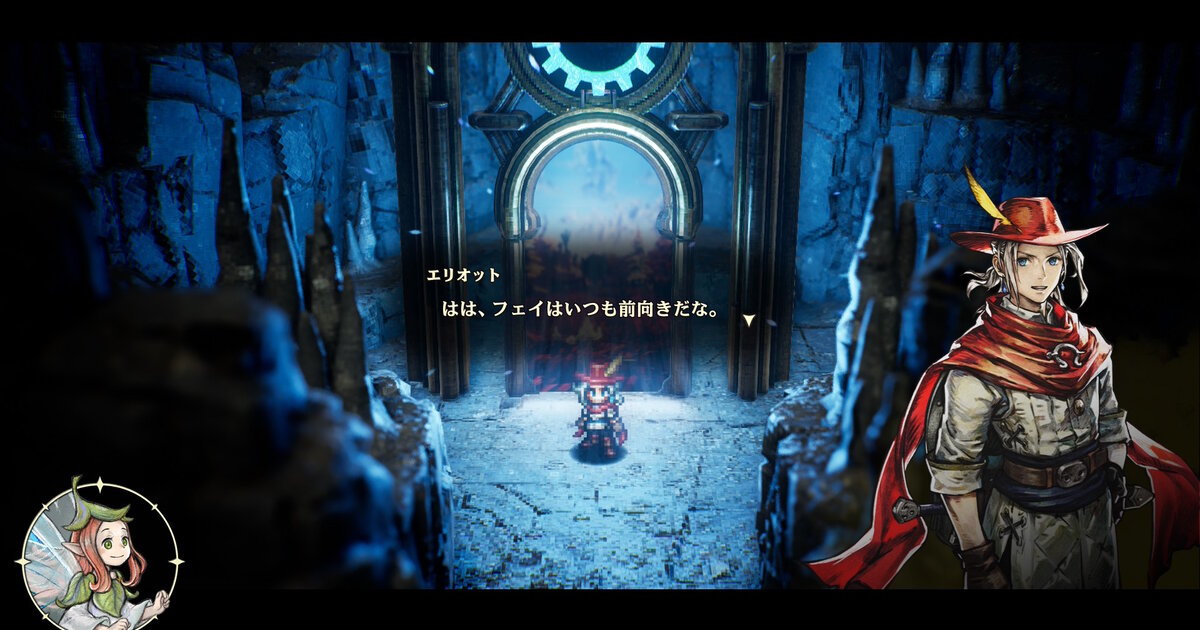
As the slogan, “Hope is always there,” suggests, this game is built around hope. In particular, that is strongly reflected in the characters’ worldview: Elliot and his companions travel through time and help people in the past, yet they never worry that their actions might cause harmful consequences for the future. The story itself also treats good deeds done in the past as good things that remain true in the future.
You could say this is too pure a take on time travel, or that it is too simple as a story. But for me, someone who mostly remembers time-SF stories like The Butterfly Effect, where historical changes turn into tragedy by way of a butterfly effect, it actually resonated with me. Honestly, given how full of irrationality the real world is, I find it more comforting when things in a game world move according to cause and effect or something like the just-world hypothesis. So personally, this did not bother me at all; if anything, I liked it. And the character who embodies that feeling is the one who joins Elliot as his partner.
That character is the fairy Fay. After the demo, Fay replaces the princess as Elliot’s partner, and she is relentlessly positive, never doubting that the future will be good and that hope is always there. Thanks to Fay’s brightness, even when painful or unavoidable things happen in the story, I could still think, well, it’ll work out somehow. The reason I was able to keep hoping for this story until the end and finish the game is, more than anything else, thanks to my partner Fay.
Other Things Worth Mentioning
Cats Everywhere
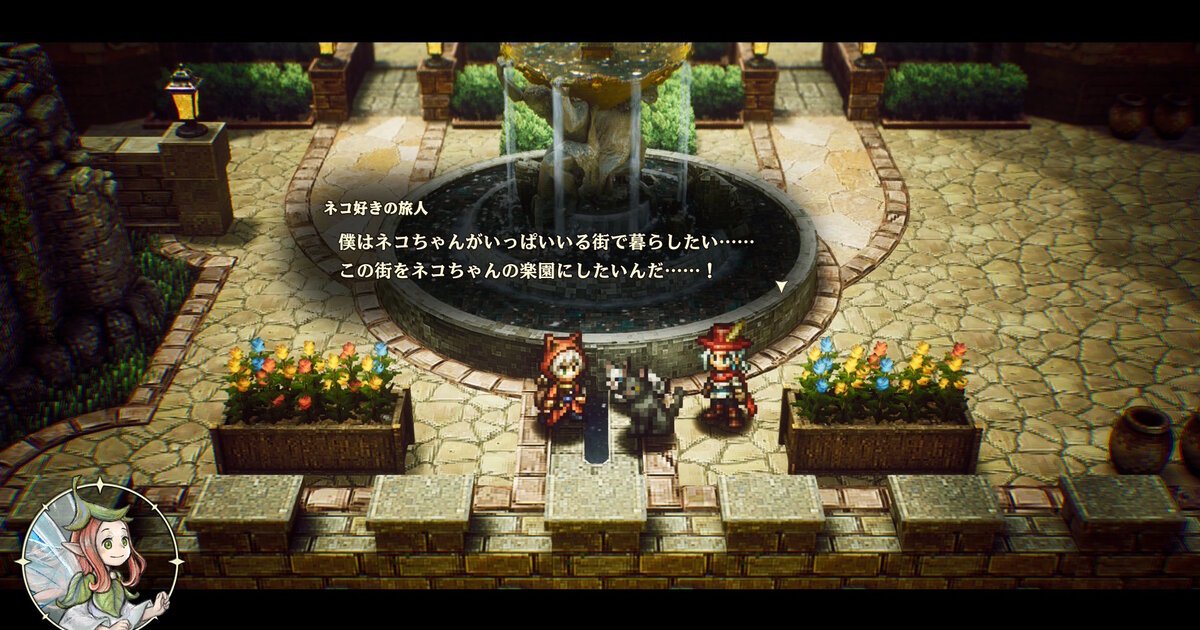
This game is packed with cat-related content. On the official site, the only clearly cat-like character you might notice is Lyudmila, the cat girl from the age of budding, but in practice there is much more. Without touching on direct story spoilers, there is a cat-loving traveler who asks Elliot to help rescue cats because he wants to play with them. As you keep rescuing them, the whole kingdom becomes filled with cats. And it’s not just about gathering them in one place: you can interact with each cat using food or toys, and once you become friends, they will even move into your house.
If I were to give this game a tag, it would have to be “cats.” It felt like a game overflowing with the feelings of people who truly love cats.
High QoL and Comfort
The QoL is very high. Fast travel is basically always available, and there is a radar-like item in the game that shows where important weapons and cats are located. So you can clear the game without having to pull up an ad-filled guide site on your phone.
There is only one thing I think the radar falls short on: it does not show the locations of Life Fragments (the equivalent of Heart Pieces in The Legend of Zelda). So if you want to find every single one on your own and max out your health, you need to search each era thoroughly. Even so, if you just collect the fragments shown on the map and go through the shrines that guarantee one, you can raise your health quite a bit, so it is not a problem for simply clearing the story.
In the end, if your goal is only to get through the story, the game remains comfortable from start to finish.
Dungeons That Rarely Change and Enemies That Never Do
The interior layout of the dungeons hardly changes even when the era does. For players who enjoy exploration, that may feel disappointing. And since there is nothing especially unique to find beyond things like the Life Fragments mentioned above, the magic stones, which only turn into a single magic-stone fragment when duplicated, or money, it can all feel underwhelming. So I think the important question is whether the player is willing to accept the idea of just following the radar, grabbing the important items, and calling it good. After all, the bosses only appear in places where they matter.
As for enemies, they barely change either. Different regions do have different enemy types, but that’s more or less the extent of it. On the positive side, that makes enemy attack patterns easier to learn, which helps with parrying and keeping chains going. Still, for players hoping for exploration or meaningful differences between eras, it will probably feel disappointing.
In Combat, Sword for Weapons and Copy for Magic Are Just Too Stable
Elliot’s seven weapons are all obtained fairly early, and Fay’s five spells are all learned by around the midgame, but even after I had everything, I kept using the sword as my main weapon and the spear as support, while mostly sticking to Copy for magic, except when a gimmick required something else. The reason was simple: the sword and Copy were just too strong and too reliable.
To explain briefly, the spear boosts the attack power of the other weapon and shortens its charge time after attacking. If you then switch to the sword, you can unleash shockwaves around yourself at high speed while the sword’s close-range attack also sends out slashes, giving you ranged offense at the same time. After that, you recover shield durability and gain the ability to guard from every direction, which is an absurdly powerful offense-and-defense setup. And Copy simply duplicates Elliot, so both damage output and attack coverage become twice as good. Honestly, if you use this combo, you can either delete bosses instantly or carefully use your shield and even clear them without taking damage. There was no real need to switch to the other weapons or spells.
Because of that, if you go in expecting to use the many weapons and spells in different ways, exploit enemy weaknesses (if the game even has such a system), and master a wide variety of tools, that expectation will unfortunately not be met. In my own experience, for example, the boomerang is strong if you can land it properly, but actually landing it properly is difficult, and even adding magic stones does not make it any easier to use, so it stayed awkward all the way through.
The Early Purchase Bonus Is Just a Bonus
The early purchase bonus accessories and magic stones were basically just extras, since they came for free. The accessories were nowhere near priority compared with other things I wanted to equip, and as for the magic stones, they were the lowest-rank ones, so in my case they were converted into a single magic-stone fragment as soon as I got them from the data carried over from the demo.
In short, even if the early purchase bonus did not exist, you would not need to worry about it. It is just a bonus that has no real impact on progression.
Conclusion: If You Want to Play a Beautifully Crafted Action JRPG, I Recommend It. Above All, Play the Demo.
To sum up, this was clearly a very well-made game from Square Enix, and I had a great time with it. So I would recommend it to anyone who wants to play a solid action “JRPG.”
That said, the feel of the action and the world itself are both things you should really experience for yourself by playing the game, so if you are even slightly interested, I strongly recommend trying the demo first. If you think it looks fun after that, and if the things I wrote above that you should not expect from this game do not bother you, then buying it and continuing on will definitely be worth it. I was completely satisfied because the demo gave me the one thing I thought I could count on: the exhilarating action and the hopeful story I mentioned above.
So, The Adventures of Elliot and the Millennium Tale was a very enjoyable game.
